What a $3 Donation Supports at China Camp
September 3, 2026
September 3, 2026
"I'm not sure exactly what I paid $3 for. The online app said I was donating." A visitor left that line in a China Camp State Park review this year, and it's a fair thing to wonder. Most state parks have a fee booth, a ranger, a sign that tells you exactly what your money buys. China Camp doesn't work that way, and once you know why, the park reads differently every time you drive North San Pedro Road.
In 2012, California suspended funding for 70 state parks rather than close them outright, and China Camp was on that list. A nonprofit called Friends of China Camp stepped in, and it has run the park's day-to-day operations ever since. There's no state budget line covering the trails, the cafe, or the museum. The organization depends on thousands of volunteer hours and community donations to keep the gates open, and by its own account, every dollar donated goes directly back into the park. That confused $3 charge wasn't a parking meter. It was closer to a shift covered than a literal paycheck: a contribution to the volunteer work that keeps the park open.
If you live in San Rafael and you've been to China Camp more than once, you've probably already met the volunteers without clocking it as volunteer work. That's the part worth slowing down on.
At China Camp Village, the historic Chinese shrimp-fishing settlement that dates to the 1860s, the person pouring your coffee at the Village Cafe is a volunteer.
Down the path at Quan Brothers Market, you're standing in a building that was somebody's actual home. Frank Quan was the village's last resident, living there until 2016, and the market still carries the family's name and its history. Nobody drew a paycheck to keep that story alive. People who cared about the place did it because the alternative was letting it disappear.
This matters for anyone weighing whether the $3 to $5 day-use fee is worth grumbling about. It's not funding a bureaucracy. It's funding the next person who shows up on a Saturday to open the snack shop or answer a question at the museum.
China Camp Beach made a Bay Area list of best swimming spots this year, which is the kind of recognition that brings more people to the water without necessarily bringing more guidance. FOCC volunteers fill that gap themselves. They post a tide chart at the Village Cafe and inside the museum, and their safety guidance is specific: come at slack tide, the window when the water is neither rushing in nor pulling out, because low tide can leave you facing mudflats instead of a swim, and strong currents build the farther out you go. Their advice is to hug the shoreline rather than swim straight out, since offshore winds make the return trip harder than the trip out.
None of that comes from a lifeguard stand. It comes from people who've watched enough visitors misjudge the bay to write it down and post it themselves.
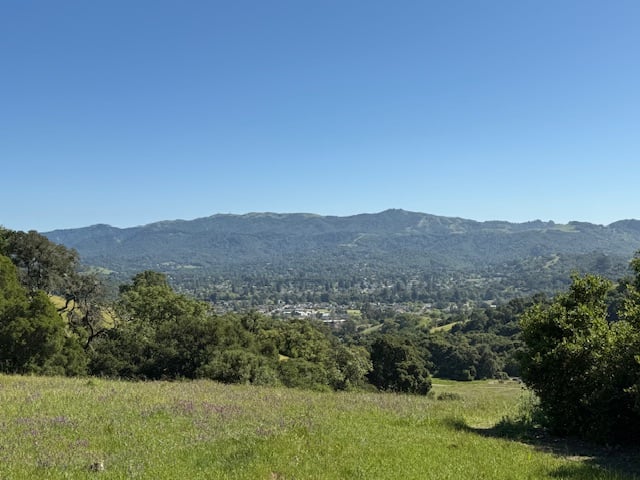
The park's 15 miles of hiking, biking, and equestrian trails, spread across roughly 1,500 acres of oak woodland and meadow plus another 100 acres of wetland, don't get maintained by a state crew either. FOCC recruits what it calls Trail Ambassadors, volunteers who wear a marked vest and hand out trail tips, note downed limbs or broken fences, and generally act as the park's eyes on the ground during regular hikes and rides. If you've ever gotten pointed toward the right fork on the Shoreline Trail by a stranger in a park vest, that's the program working as designed. Anyone interested can reach the volunteer coordinator directly through Friends of China Camp.
The same volunteer logic shows up in the park's emergency locator system: small black numbers in yellow circles, bolted to trail posts, trailheads, and bridges throughout the property. If something goes wrong on a remote stretch of the Bayview Trail, you read off the nearest number to a 911 dispatcher instead of trying to describe your location. It's a low-tech fix built for a park that doesn't have a ranger stationed at every junction.
This year, the China Camp Trail Run took over Miwok Meadows on May 23 for a half marathon, 10K, and 5K, sending runners over single-track that climbs through oak forest before dropping into open grassland along San Pablo Bay. Dogs were welcome at the start and finish area but not permitted on the actual trails that day, a stricter rule than the park's usual policy of leash-only access in picnic and camping zones. The race has landed on a different month in past years, so if your regular loop runs through Miwok Meadows, it's worth checking the calendar each spring rather than assuming the date repeats exactly.
Late summer and early fall are wildfire season in Marin, and China Camp treats that seriously in a way that again traces back to volunteer labor rather than a state fire crew. Fire Safe Marin's criteria for red-flag warnings, hot, dry, gusty conditions, trigger heightened caution throughout the park, and FOCC volunteers spend the year removing dead trees, clearing invasive brush, and cutting back flammable grasses in developed areas. That work benefits more than just hikers. FOCC has partnered with city, county, and state agencies specifically to reduce fire fuel not just inside the park boundary but in the neighborhoods around it, which means the folks trimming brush at China Camp are doing something that protects Peacock Gap and Santa Venetia too. Before a hike on a hot, windy day, it's worth checking the National Weather Service's current advisories rather than assuming the trail is open as usual.
None of this means China Camp asks more of you than any other state park. If anything, it asks for something simpler: paying the day-use fee without treating it as an inconvenience, saying hello to the volunteer behind the cafe counter, and understanding that the tide chart taped to the wall exists because someone drove out and updated it. The park has stayed open for over a decade past the point California stopped funding it, entirely because residents decided it was worth keeping. That's a different relationship than the one most people have with a state park, and it's one that rewards a little bit of attention.
If you're new to the neighborhoods near China Camp, whether that's Peacock Gap, Santa Venetia, or elsewhere in San Rafael, it's the kind of local detail that tells you more about daily life here than any listing photo can. Team O'Brien - David & Deirdre spends as much time learning the texture of these towns as we do the market data, and we're always glad to talk through what makes a specific pocket of Marin feel like home. If you're weighing a move in San Rafael or just want a second opinion on a neighborhood you're already circling, reach out for a conversation, no pressure, just local knowledge.
San Rafael California Real Estate
San Rafael Real Estate Market Update
Novato Real Estate
Novato Real Estate Market

Novato Real Estate
Novato Real Estate Market
At Team O’Brien, real estate isn’t just about buying and selling homes—it’s about helping you make the right move with confidence. Whether you’re buying, selling, or investing, we take the time to understand your goals and provide tailored solutions for success.